Start with a scar map, not a package
If every acne scar receives the same treatment recommendation, ask what the examination actually found. A useful consultation identifies which marks are depressed, raised or primarily changes in color. Use our Chicago med spa comparison to create a shortlist, then ask which providers regularly assess acne scarring rather than assuming every listed clinic offers scar procedures.
Prepared by the Chicago Med Spa Reviews editors. This is general patient education and has not been reviewed by a clinician. Our review methodology and relationship disclosures explain how the site operates.
The AAD acne scar treatment guide describes several approaches, including resurfacing, microneedling and procedures directed at individual scars. Because scar types differ, compare plans for your particular scars. A fashionable device name alone does not explain why a treatment fits.
Ask the clinician to mark your main concerns on a photograph taken in consistent lighting. Save that baseline and agree what a worthwhile improvement would look like. This makes later reviews more useful than trying to remember your skin before treatment.
The AAD descriptions of scar types include ice pick, rolling and boxcar depressions as well as raised scars. These are terms to discuss with the examiner, not diagnoses to assign yourself. The AAD treatment overview includes laser resurfacing, chemical peels, microneedling and scar surgery; a clinician can explain whether one or more fits your findings.
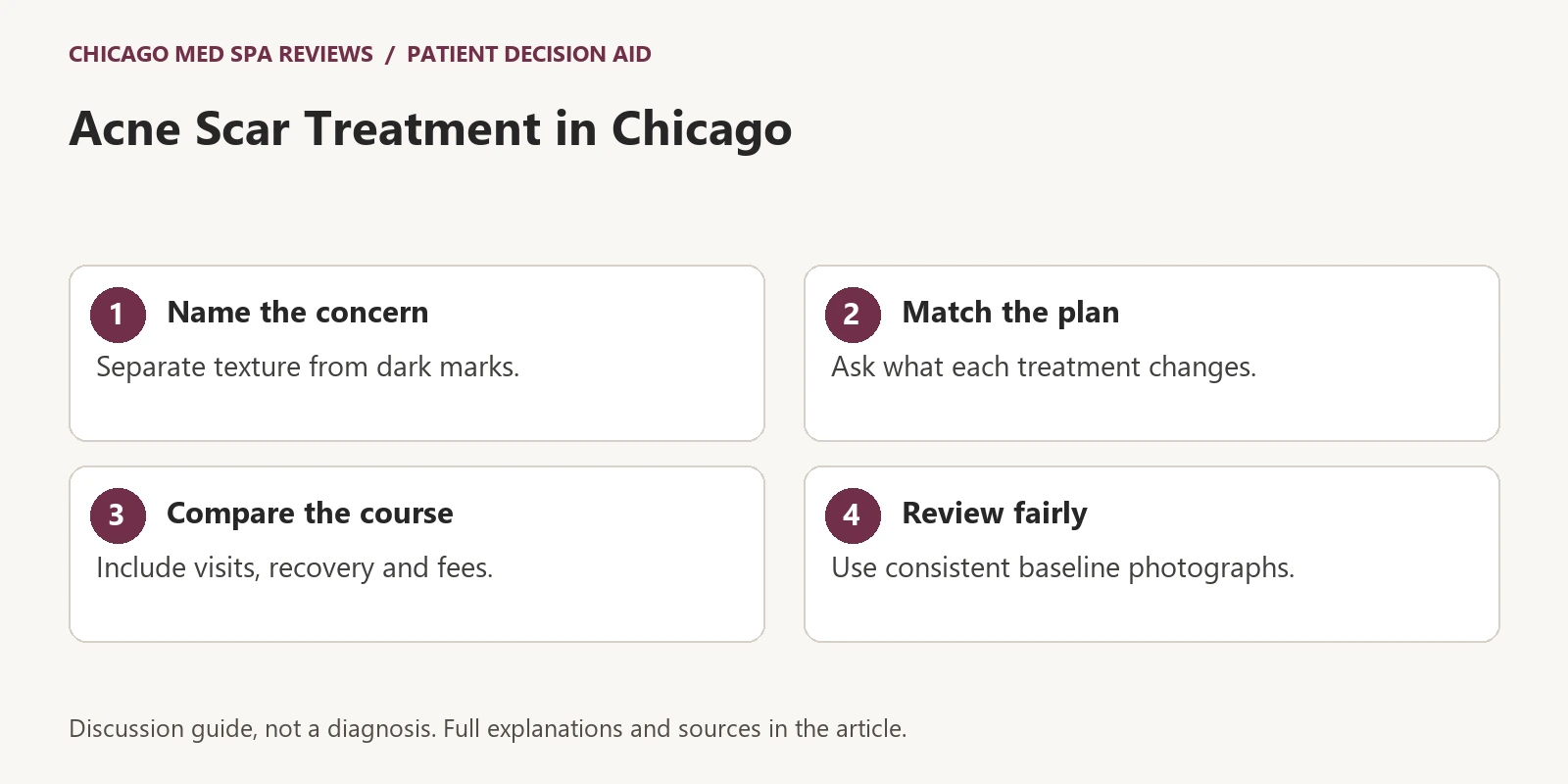
Use the four-step roadmap to organize your visit: Name the concern, match the plan, compare the course, review progress.
Compare the problem each approach is intended to address
The table is a consultation aid, not a prescription. People often have more than one scar pattern, so a clinician may combine approaches or treat different areas separately. Ask what each proposed step contributes and what it cannot change.
| Finding to discuss | Approaches a clinician may discuss | Question that clarifies the plan |
|---|---|---|
| Flat discoloration | Pigment assessment and a skin care plan | Is this a scar, a dark mark, or both? |
| Broad depressions or uneven texture | Microneedling or resurfacing assessment | Which scars do you expect this to improve? |
| Deep or tethered depressions | A clinician’s assessment for targeted scar procedures | Would surface treatment alone leave the main problem? |
| Raised scars | Dermatology assessment before cosmetic resurfacing | Does my history change the risk of further scarring? |
Understand what is actually being used
Conventional microneedling and RF microneedling are different procedures. RF adds radiofrequency energy through small electrodes, producing heat in tissue. The FDA microneedling overview explains that specific devices are authorized for specific uses, and that microneedling devices are not approved to deliver cosmetics, drugs or blood products into skin. Ask for the exact device and its intended use. If energy delivery is proposed, read our RF microneedling safety guide.
If PRP or another add-on appears on the estimate, ask which parts of the combination have evidence and what additional risks and charges apply. Read our microneedling guide before deciding between those options. More components do not automatically mean better results.
Give your clinician the history that changes the plan
Bring a list of active acne treatments, medicines, previous procedures and any history of raised scars or persistent dark marks after irritation. Ask whether active acne should be controlled first and whether your skin needs preparation. Let the clinician decide timing; do not stop prescribed medicine to fit a promotional appointment.
For example, a Chicago commuter with old cheek depressions, ongoing breakouts and dark marks needs three questions answered: what prevents new lesions, what treats color, and what treats texture? Booking a resurfacing series without separating those goals makes it difficult to judge whether the plan is working. This example is hypothetical and does not predict anyone’s response.
Discuss current or recent isotretinoin, blood thinners, cold sores, pregnancy or breastfeeding, and any history of keloids. For darker skin, ask specifically how the plan accounts for pigment changes after inflammation. The AAD microneedling guide and FDA device information should be read together: general claims about suitability across skin tones do not replace assessment of the exact device and your history. Compare the laser resurfacing questions if a laser is proposed.
Compare a complete course, including the review point
Request the number of sessions initially proposed, the treatment area, anesthesia charges, aftercare supplies and the follow-up policy. Ask when the clinician will decide whether to continue, adjust or stop. There is no verified citywide price sample in this guide; a single advertised starting price cannot establish the cost of your scar plan.
Our Chicago pricing guide explains how to compare estimates. For a scar program, add a column for recovery days and travel visits. A clinic close to work may be convenient, but the ability to attend a clinical review and reach the treating team should carry more weight than convenience alone.
- Request the scar diagnosis and treatment goal for each area.
- Ask to see appropriately consented examples with similar scar patterns and skin tone.
- Get the full initial course estimate, exclusions and cancellation terms.
- Record the clinician’s after-hours contact and instructions for unexpected symptoms.
- Agree on photographs and a review date before buying more sessions.
- Confirm who examines you and performs each step, their license type and who is responsible for complication assessment.
- Ask which changes require prompt medical review, including increasing pain, spreading redness, discharge, fever or blistering.
Judge progress without a perfection promise
Compare photographs under the same lighting and camera distance. Ask whether the observed change is in texture, color, or both. Be wary of comparisons that use makeup, dramatically different angles or a short interval that mainly shows swelling.
Improvement can be meaningful without erasing every scar. Before consenting, ask what residual problems are likely and which alternatives remain if the first approach does not meet your goal. This guide supports a consultation; it does not diagnose scar types or select a procedure for you.
Frequently Asked Questions
What is the best treatment for acne scars?
There is no single best treatment for every scar. The important first step is identifying the scar pattern, skin tone, active acne and prior healing problems. Ask a dermatologist which options address your particular scars and what a realistic improvement would mean before comparing packages or device brands.
Is microneedling or laser better for acne scars?
Either may be discussed, depending on the scars and your risk profile. Ask what each approach would change, the expected course and recovery, and whether a targeted procedure is also needed. Conventional microneedling and RF microneedling are different procedures, so the comparison must name the exact device.
Can acne scars be completely removed?
Do not assume that treatment will erase every scar. Ask the clinician to describe the likely degree of improvement and the limitations for your scar pattern. Consistent photographs and an agreed review point help distinguish an improvement in color or lighting from a real change in skin texture.
How much does acne scar treatment cost in Chicago?
A useful estimate requires an examination and a defined plan. Ask for the treatment area, initial session count, anesthesia, aftercare and follow-up charges in writing. This guide does not establish a Chicago average. Compare the complete course and recovery commitments rather than choosing by a single advertised session price.
Sources
- Acne scars: Consultation and treatment, American Academy of Dermatology
- Microneedling can fade scars, uneven skin tone, and more, American Academy of Dermatology
- Microneedling Devices, U.S. Food and Drug Administration
- Acne scars: Signs and symptoms, American Academy of Dermatology