What the FDA warning actually says
Before booking RF microneedling in Chicago, read the warning rather than relying on a package description. Our Chicago med spa selection guide helps assess providers; RF also requires a discussion of the specific device and energy-based procedure.
Prepared by the Chicago Med Spa Reviews editors. This is general patient education and has not been reviewed by a clinician. Our review methodology and relationship disclosures explain how the site operates.
In its October 15, 2025 RF microneedling safety communication, the FDA describes serious reported complications with certain uses, including burns, scarring, fat loss, disfigurement and nerve damage. Some reports involved medical intervention or surgical repair. The communication describes an ongoing evaluation; it does not provide a personal probability of harm.
Read the current notice when making a decision. A report of harm should be taken seriously without assuming that it establishes how often the complication occurs in every setting. Ask the clinician how the warning affects their assessment, consent discussion and procedure selection.
FDA communication checked on October 19, 2026. It may be updated; use the linked FDA page for its current wording and status.
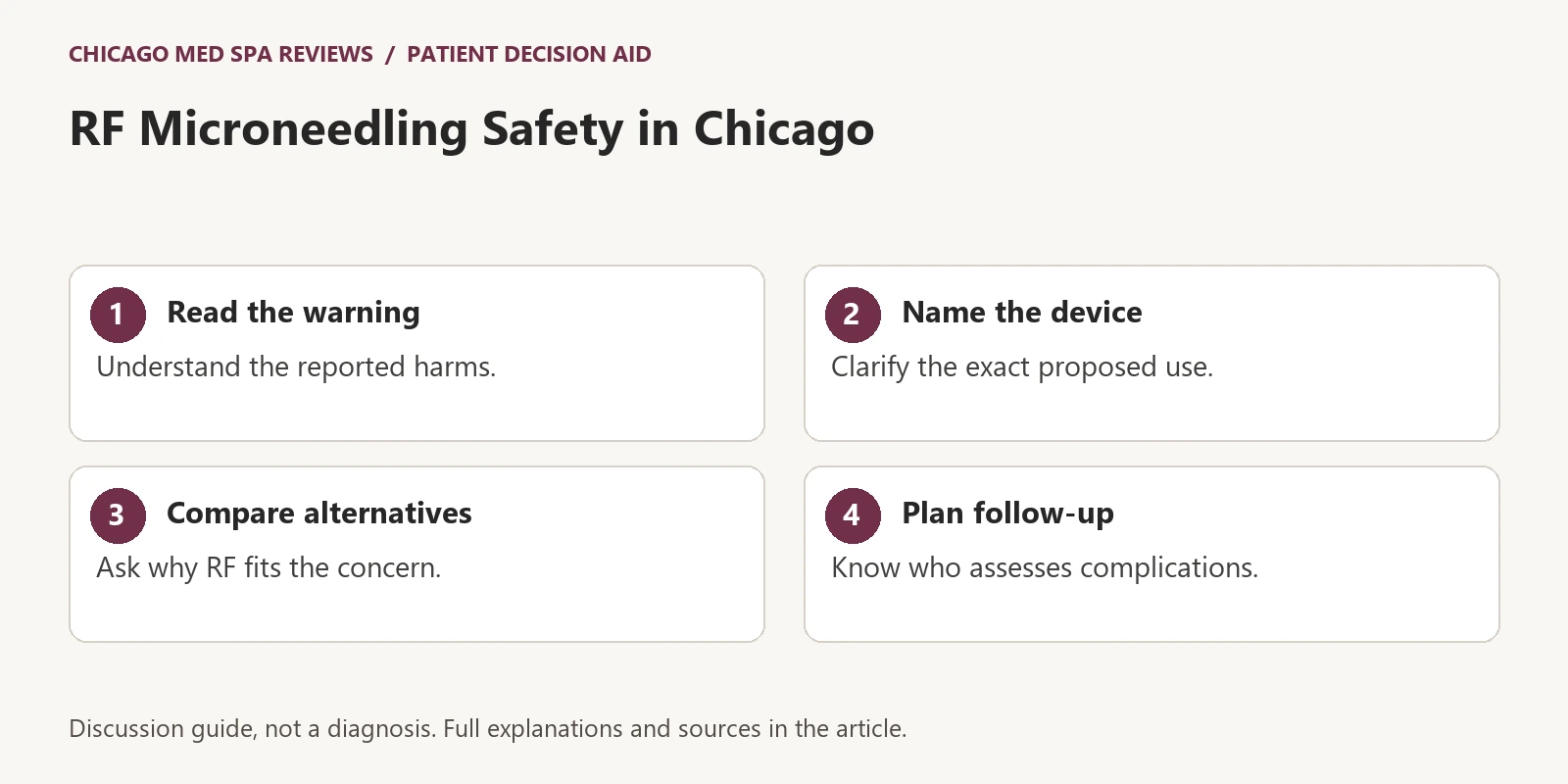
Use the four-step roadmap to organize your visit: Read the FDA warning, name the device, compare alternatives, plan follow-up.
Conventional microneedling and RF are different
Conventional microneedling uses needles to create controlled punctures. RF systems also deliver radiofrequency energy through small electrodes. The addition of energy changes what needs to be discussed, including tissue effects, the treatment area and operator training.
| Question | Conventional microneedling | RF microneedling |
|---|---|---|
| What is being used? | A needle-based device | Needles or small electrodes that also deliver RF energy into skin |
| What should be named? | Exact device and intended use | Exact device, intended use and energy-based approach |
| What should not be assumed? | That add-on products are approved for delivery into skin | That add-on products are approved for delivery into skin |
| What must be planned? | Assessment, hygiene and aftercare | Assessment, device training, risks and follow-up |
Questions that make the consultation concrete
Ask what diagnosis or concern is being treated, why RF is proposed over conventional microneedling or another option, and what realistic improvement would mean. Read the Morpheus8 guide for background on that named platform, but do not assume every RF system is the same.
Discuss medicines, including current or past isotretinoin, pregnancy or breastfeeding, electronic or metal implants, active skin problems, cold sores and previous scarring or pigment changes. These are topics for assessment, not a self-screening list of contraindications. Your clinician should explain what changes the plan and choose device settings.
- Get the device name and the reason it fits the proposed use.
- Ask about training with that device and treatment area.
- Discuss the FDA warning and alternatives explicitly.
- Request written risks, recovery instructions and review arrangements.
- Confirm who manages an unexpected injury and the after-hours contact.
- Confirm the treating professional’s license type, device training and clinical oversight. Use the Illinois license lookup guide to check names.
A practical example: compare alternatives before a package
Imagine a patient seeking improvement in cheek texture who is offered a discounted RF series. The useful comparison is not how much energy each clinic promises, but whether the diagnosis, alternatives and expected improvement are explained. Ask why the additional energy is justified for the goal and what would make conventional treatment preferable. This is a hypothetical example.
Our conventional microneedling guide and scar treatment guide can organize those questions. A plan may reasonably include waiting or choosing another approach; a promotion should not settle the clinical decision.
Plan for assessment if something goes wrong
Before treatment, ask which skin changes are expected, how they should improve and which need an earlier assessment. Concerning burns, increasing pain, spreading redness, discharge, new numbness or changes in facial contour need prompt medical review. Call 911 for sudden weakness, trouble speaking or difficulty breathing. Seek same-day urgent medical care for severe pain, fever with spreading redness, blistering or open wounds.
Keep the device name, treatment date, records and photographs. The FDA asks patients and providers to report complications, including through MedWatch. Reporting is separate from getting medical care. The AAD microneedling overview also emphasizes professional assessment and appropriate treatment selection.
Ask whether consultation, the initial course, aftercare and review are included in the price. This guide has no verified Chicago price sample. Its purpose is to help you evaluate an informed-consent discussion, not to declare a device safe or unsafe for your personal circumstances.
Frequently Asked Questions
Did the FDA ban RF microneedling?
The cited October 15, 2025 communication warns about serious reported complications and describes an ongoing evaluation. It should not be read as proof of a blanket ban or recall of every RF device. Check the current FDA notice and ask about the exact device and proposed use before deciding.
Is RF microneedling the same as regular microneedling?
No. RF microneedling adds radiofrequency energy delivery to a needle-based procedure. That changes the treatment discussion and risk assessment. Ask the clinician why RF is appropriate for your concern, what alternatives exist and what the exact device is rather than treating both procedures as interchangeable versions of one service.
Does FDA clearance mean RF microneedling is risk-free?
No. Regulatory status relates to particular devices and uses and does not eliminate procedure risks. Ask how the proposed treatment relates to the device labeling and how the clinician selects the approach for you. Marketing language about clearance does not replace a discussion of complications, alternatives and follow-up.
What should I do after a concerning RF microneedling reaction?
Contact a qualified clinician promptly for burns, increasing pain, new numbness or changes in contour. Call 911 for sudden weakness, trouble speaking or difficulty breathing. Seek same-day urgent care for severe pain, fever with spreading redness, blistering or open wounds. Keep records; FDA reporting does not replace medical care.
Sources
- Potential Risks with Certain Uses of Radiofrequency Microneedling, U.S. Food and Drug Administration
- Microneedling Devices, U.S. Food and Drug Administration
- Microneedling can fade scars, uneven skin tone, and more, American Academy of Dermatology
- MedWatch: FDA Safety Information and Adverse Event Reporting Program, U.S. Food and Drug Administration