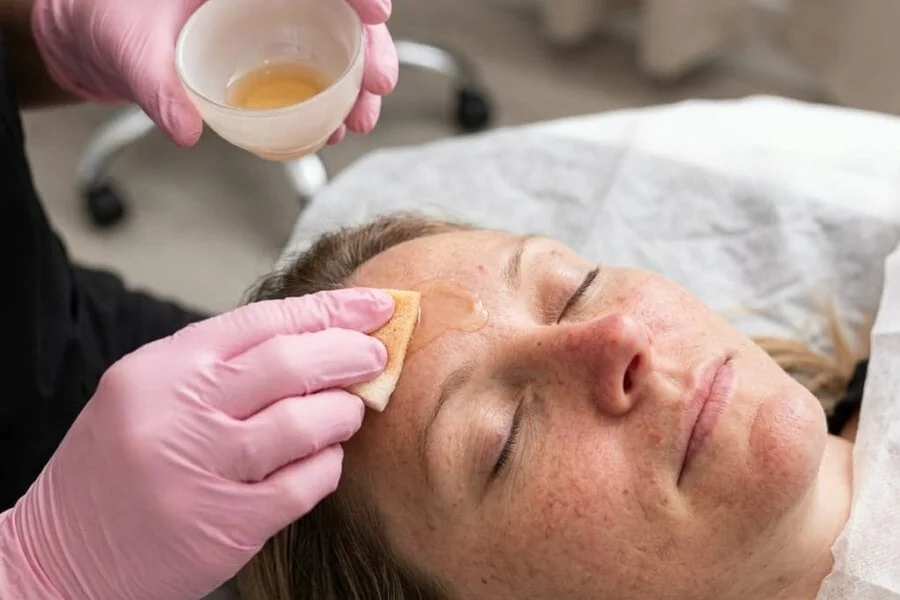
What is a chemical peel?
A chemical peel is an acid solution a provider applies to the skin to exfoliate it to a chosen depth. The American Society for Dermatologic Surgery (ASDS) classifies peels as superficial, medium or deep by how far the solution penetrates, and that depth decides how long you heal and, in Illinois, who is allowed to perform the peel.
Superficial peels, which ASDS also calls lunchtime peels, use alpha-hydroxy acid or another mild acid to reach only the outer layer of skin. Medium peels use glycolic or trichloroacetic acid (TCA) to reach the outer and middle layers. Deep peels use TCA or phenol to penetrate deeply into the middle layer.
Depth is not fixed by the product name alone. A 2018 peer-reviewed review in the Journal of Clinical and Aesthetic Dermatology explains that depth depends on the acid, its concentration, the number of coats and how long it stays on the skin, and describes chemical exfoliation as "cumulative dose-dependent."
Superficial, medium and deep peels compared
The deeper the peel, the longer the recovery and the tighter the legal limits on who performs it. In the table, layers and agents come from the 2018 review, healing times from the American Academy of Dermatology (AAD), sessions from the AAD and ASDS, and the Illinois column from IDFPR guidance covered below.
Two details from the review are worth knowing before a consultation. Medium-depth peels commonly apply a pre-treatment such as Jessner's solution or dry ice before TCA, in combinations known as the Monheit, Brody and Coleman peels, and high-concentration TCA used alone "has fallen out of favor" because of its complication risk. For deep peels, the review calls the Baker-Gordon phenol formula "the preferred agent of choice."
| Depth | Layer reached | Common agents | Healing time (AAD) | Sessions | Who may perform it in Illinois |
|---|---|---|---|---|---|
| Superficial (light) | Epidermis only | Glycolic acid 30 to 50%, lactic acid 10 to 30%, mandelic acid 40%, salicylic acid 30%, pyruvic acid 50% | 1 to 7 days; skin is red and may scale | Often a series: the AAD says 3 to 5 peels may be necessary, every 2 to 5 weeks | Within an esthetician's scope, because IDFPR carves superficial peels out of the practice of medicine |
| Medium | The entire epidermis and the papillary dermis | Glycolic acid 70% or TCA 35 to 50%, often after Jessner's solution or dry ice | 7 to 14 days; skin is red and swollen, and blistering is possible | Typically a single treatment | Practice of medicine: a physician, or a person the physician delegates it to under IDFPR's conditions |
| Deep | Down to the mid-reticular dermis | Phenol and croton oil (the Baker-Gordon formula); high-concentration TCA, now rarely used alone | 14 to 21 days; the area is bandaged at first and several follow-up visits are needed | ASDS: once per lifetime, face only | Practice of medicine: a physician, or a person the physician delegates it to under IDFPR's conditions |
Are chemical peels good for your face?
They can help specific problems, within clear limits. The American Society of Plastic Surgeons (ASPS) says chemical peels can improve acne and acne scars, fine lines and wrinkles, irregular pigmentation, rough or scaly skin, certain scars and sun-damaged skin.
ASPS is just as direct about what a peel cannot do: it "cannot treat deep facial lines or wrinkles," "significantly tighten loose or sagging skin," or "remove deep scars." A pitch that presents a peel as a substitute for tightening or deep-wrinkle treatment runs against that patient information.
The acid matters as well as the depth. At the 2024 Pigmentary Disorders Exchange Symposium, Dr. Seaver Soon, a Mohs surgeon and cosmetic dermatologist, said the greatest evidence for treating melasma is with glycolic acids, and the greatest evidence for treating post-inflammatory hyperpigmentation and acne scars is with salicylic acid at 20 to 30%, according to a Next Steps in Dermatology summary of his talk.
If you are weighing a light peel against other facial treatments, our HydraFacial guide covers that option separately.
What is a VI Peel?
VI Peel is a branded chemical peel made by VI Aesthetics, which sells it under the VI Derm name on its consumer website and markets it as a "Medium Depth Chemical Peel." A clinic website, enviaesthetics.com, describes it the same way, as a medium-depth peel that "penetrates your skin's top layer, known as the epidermis, and enters into the dermis beneath the skin's surface."
What is in it: clinic pages we checked describe the formula as a blend of trichloroacetic acid (TCA), salicylic acid, phenol, retinoic acid (tretinoin) and vitamin C. VI Aesthetics' consumer website did not publish an ingredient list with percentages when we checked in September 2026, and the percentage figures that circulate on clinic blogs could not be traced to the manufacturer, so we do not repeat them.
The manufacturer names several versions: VI Peel Original, VI Peel Purify (positioned for acne), VI Peel Precision Plus (positioned for pigmentation and melasma), VI Peel Purify with Precision Plus, VI Peel Advanced, VI Peel Body, and an add-on called ToxBooster.
What the first week looks like: a patient-education page from Advanced Body & Laser Center, a clinic that offers the peel, says the solution stays on the skin for 4 to 6 hours on treatment day, most patients begin to see visible peeling on day 3 (typically around the mouth and chin), peeling is most active on days 4 and 5, and it slows on days 6 and 7. That is one clinic's description of a typical experience, not a VI Aesthetics protocol.
VI Aesthetics also markets the peel as "Safe For All Skin Types." Treat that as a marketing claim. The same enviaesthetics.com page cautions that "those with sensitive skin, poor wound healing, and those with darker skin types for whom peels and laser treatments may pose an additional risk should avoid the procedure." Read the risks section below before booking.
Do dermatologists recommend chemical peels?
The two US dermatology societies cited here publish patient guidance on chemical peels as a dermatologic treatment chosen by depth, with specific cautions, rather than a blanket recommendation that everyone get one.
The American Society for Dermatologic Surgery lists chemical peels among its skin treatments and describes all three depths. The American Academy of Dermatology's chemical peel FAQ sets out healing time by depth, says a light peel may need to be repeated as a series, and advises that people who have skin of color see a dermatologist who has expertise in treating darker skin to avoid permanent pigment problems.
Dermatology groups have also addressed specific situations: in 2017 an ASDS expert panel concluded that superficial chemical peels can be performed safely in people currently or recently treated with isotretinoin (details below).
In practice, whether a peel is right for you depends on your skin concern, skin tone and medical history, which is a question for an in-person examination.
How much downtime does a chemical peel need?
Plan on 1 to 7 days of healing after a light peel, 7 to 14 days after a medium peel and 14 to 21 days after a deep peel, according to the AAD. After a light peel the skin is red and may scale; after a medium peel it is red and swollen; after a deep peel the area is bandaged at first.
Sun protection is the core of aftercare. The AAD calls for total avoidance of the sun until the skin heals after a medium peel, and total sun avoidance for 3 to 6 months after a deep peel. Once your skin has healed, daily sunscreen is needed indefinitely after any peel.
The AAD and ASDS list habits that raise the risk of infection and scarring: scratching the skin, picking scabs, applying makeup too early and using tanning beds. ASDS adds that sun exposure and smoking after a chemical peel must be avoided.
Deep peels also require several follow-up visits. If you are timing a peel around Chicago's seasons, see our Chicago winter skin treatments guide.
How long does a chemical peel last?
A chemical peel treats existing damage but does not prevent new sun damage or aging, so how long results hold depends on the depth you chose and how well you protect your skin afterward. The sources in this guide describe how often peels are repeated rather than giving a fixed number of months.
Light peels are the ones people repeat: the AAD says 3 to 5 peels may be necessary, spaced every 2 to 5 weeks. Medium and deep peels are typically single treatments, and ASDS describes a deep peel as a once-per-lifetime treatment for the face only.
Be cautious of any promise that one peel gives permanent results. The AAD's guidance is that daily sunscreen is needed indefinitely after a peel once the skin has healed.
What are the risks, especially for darker skin tones?
Every depth carries some risk. The AAD and ASDS list persistent redness, temporary or permanent changes in skin color (darkening or lightening), infection, cold sore (herpes simplex) reactivation and, rarely, scarring.
ASDS flags a higher chance of lasting color change in two groups: women on birth control pills who subsequently become pregnant, and people with a personal or family history of brownish facial discoloration.
For darker skin tones, the AAD's advice is specific: people who have skin of color should see a dermatologist who has expertise in treating darker skin, to avoid permanent pigment problems. We could not find a verified chemical-peel-specific rate of post-inflammatory hyperpigmentation (PIH, darkening after inflammation) by skin type, so treat any precise percentage a clinic quotes with caution and ask where it comes from.
Providers can adjust a peel's strength through the acid, its concentration, the number of coats and contact time, per the 2018 review. As one clinician's example, Dr. Soon said he prefers a modified Jessner's solution for patients with skin of color, using citric acid in place of resorcinol (a known contact irritant), because of its reduced risk of irritation.
VI Peel is a case in point: the manufacturer markets it as safe for all skin types, while at least one clinic page advises people with darker skin types to avoid it. Ask how many peels of the recommended depth your provider has performed on skin like yours.
Who should wait or get medical advice first?
Tell your provider if you have had cold sores, take or recently took isotretinoin, or are pregnant or planning a pregnancy; each changes the conversation.
Cold sores: a 2021 guideline from the Complications in Medical Aesthetics Collaborative (CMAC), a UK clinician group, published in the Journal of Clinical and Aesthetic Dermatology, advocates antiviral prevention for patients who have had a herpes outbreak after an aesthetic procedure that breaches the skin, and it names chemical peels. It also notes there is "no definitive evidence base on the actual risk of reactivation following minimally invasive procedures." A 2000 randomized trial of 84 facial resurfacing patients (laser, chemical peel, dermabrasion or a combination) found valacyclovir prevented reactivation in both dosing schedules tested. Whether you need an antiviral is a prescriber's decision.
Isotretinoin (Accutane): traditional practice was to avoid chemical peels and several other skin procedures within 6 months of isotretinoin. A 2017 ASDS expert-panel consensus in Dermatologic Surgery found the evidence insufficient to justify delaying superficial chemical peels and concluded they can be performed safely in people currently or recently treated with isotretinoin. For medium and deep peels it found insufficient data to make a recommendation, cautioning that insufficient evidence "should not be misconstrued as a confirmation of safety," as reported by Dermatology News.
Pregnancy: the InfantRisk Center at Texas Tech University Health Sciences Center says that because ingredient concentrations and combinations vary, "it is best to postpone chemical skin peels until after delivery." Its ingredient notes: trichloroacetic acid peels should be avoided in pregnancy, it is best to avoid glycolic acid until further research has been done, topical salicylic acid is considered safe, and topical retinoids should be avoided during pregnancy and the preconception period.
Clinic pages describe VI Peel as containing retinoic acid (tretinoin), which would place it in that last group. That is our reading of the ingredient list against InfantRisk's retinoid guidance, not a warning published by VI Aesthetics. The InfantRisk guidance cited here addresses pregnancy; if you are breastfeeding, ask your own clinician.
Who can perform a chemical peel in Illinois?
In Illinois the dividing line is whether the peel is superficial. Illinois estheticians and cosmetologists may perform superficial chemical peels, but peels beyond that depth are treated as the practice of medicine. The Illinois Department of Financial and Professional Regulation (IDFPR), in its Statement on Prohibited Practices dated April 6, 2026, lists "Chemical peels, except for superficial chemical peels" among procedures that "constitute the practice of medicine" and "are not within the scope of practice of a cosmetologist or an esthetician."
That statement rests on the rule that cosmetologists and estheticians "are prohibited from using any technique, product, or practice intended to affect the living layers of the skin," citing the Barber, Cosmetology, Esthetics, Hair Braiding and Nail Technology Act of 1985 (225 ILCS 410/3-1 and 410/3A-1). Two 2025 laws, Public Act 104-134 and Public Act 104-153, amended the esthetics definition in 225 ILCS 410/3A-1, which the Illinois General Assembly's website currently prints as two parallel versions. Both keep that living-layers sentence, so the superficial-peel line is unchanged. A joint IDFPR and Illinois Department of Public Health memo on medical spa services, updated October 30, 2025, repeats the same exception.
In plain terms, a superficial peel may be performed by a licensed esthetician. A deeper peel generally requires a physician (MD or DO) or a provider working under a physician's delegation. The state's guidance draws its line at superficial only; it does not name medium or deep peels separately. Because VI Aesthetics markets VI Peel as medium depth, ask any clinic that offers it who performs it and which physician directs the treatment.
When a physician delegates one of these procedures, IDFPR's statement requires that the person treated be the physician's patient, that the physician examine the patient and determine the appropriateness and course of treatment, and that the delegate carry out the treatment as instructed without holding themselves out as a cosmetologist or esthetician.
The memo also quotes the Illinois laws that let physicians delegate patient care tasks to nurses (225 ILCS 60/54.2) and let advanced practice registered nurses with full practice authority practice without a written collaborative agreement (225 ILCS 65/65-43). Our guides to the medical director's role in Illinois med spas and Illinois med spa laws cover those arrangements.
Before any peel that is not superficial, confirm the license of the person treating you and of the directing physician. Our step-by-step guide to verifying Illinois med spa licenses shows how to use IDFPR's free license lookup. This section is general information, not legal advice; confirm current requirements with IDFPR.
How much does a chemical peel cost in Chicago?
It depends mainly on the peel's depth and brand, the area treated and whether you buy a series, and there is no current national chemical peel fee from ASPS to compare a quote against.
The 2025 ASPS Procedural Statistics Report, the current edition, contains no chemical peel procedure count and no average fee; ASPS says it is "seeking a data source that aligns with its cosmetic and reconstructive data sets before estimating treatment counts" for minimally invasive treatments. Its only chemical peel figure comes from a survey of ASPS member surgeons, 33% of whom said they used chemical peels for facial rejuvenation in 2025. That measures surgeon use, not patient numbers or prices.
Judging by how the clinics in the next section publish prices, quotes move with the product (VI Peel, PRX and PCA Skin peels are listed separately from standard peels), the area (face versus chest or upper back, or eye area versus full face), single treatment versus a series (several sell a series of three, and one labels its package a first-time client special), and promotions (one shows a regular price beside a lower promotional price). The sample mixes med spas and surgical practices, so ask who performs the peel at the price you are quoted.
"Starting at" means the lowest price for that peel, not what your treatment will cost. For how med spa pricing works more generally, read what Chicago med spa pricing actually looks like.
Published prices from Chicago-area clinics (observed September 2026)
Each price below is copied word for word from the clinic's own website, with the clinic's qualifiers kept. Prices observed on each clinic's website in September 2026. Prices change; confirm with the clinic.
This is a sample, not a ranking or an endorsement, and prices for different peels, depths and areas are not comparable with each other. We have not averaged these figures or turned them into a range. Clinics that are clients of the company that operates this site are not included.
| Clinic | Peel | Published price (verbatim) | Pricing basis | Source |
|---|---|---|---|---|
| SpaDerma | Standard Chemical Peel | "$199" | One session. The page also offers "Buy 2 Sessions Save 25%". | spaderma.com |
| SpaDerma | VI Peel | "Starting at $375" | Per treatment, starting price | spaderma.com |
| SpaDerma | PRX peel | "Starting at $350" | Per treatment, starting price. The page notes SkinCeuticals TCA and PCA Skin Retinol peels are priced separately. | spaderma.com |
| Fulcrum Aesthetics | Chemical peels (the page names PCAskin, VI Peel and a Retinol Peel) | "The cost of chemical peels begins at $250+." | Per treatment, starting price, for the clinic's peels as a group | fulcrumaesthetics.com |
| Solve Med Spa | VI Peel | "$325.00" (single); "$825" (3 treatments) | Single treatment, or a 3-treatment package the site labels "First-Time Client Special" | solvemedspa.com |
| Solve Med Spa | PCA Peel | "$175" (single); "$450" (3 treatments) | Single treatment, or a 3-treatment package | solvemedspa.com |
| Solve Med Spa | Chemical peel (general) | "Chemical peel Chicago IL starting at $150 per treatment" | Per treatment, starting price | solvemedspa.com |
| Chicago Oculofacial Plastic Surgery (Dr. Phelps) | Periocular chemical peel | "our periocular chemical peel starts at $350"; "a series of three periocular peels starts at $1,000" | Single treatment (starting price), or a series of three (starting price) | drphelps.com |
| Chicago Oculofacial Plastic Surgery (Dr. Phelps) | Full-face chemical peel | "our full-face chemical peel begins at $500"; "a series of three is priced at $1,250" | Single treatment (starting price), or a series of three | drphelps.com |
| Bella Sana Med Spa | Chemical peel by area | Face "$79.00", shown as "Now $49.00"; Decollete "$99.00", shown with "$79.00"; Upper Back "$149.00", shown with "$99.00" | Per session, by treatment area. The site shows a regular price beside a lower promotional price. | bellasanamedspa.com |
Questions to ask at your chemical peel consultation
A good consultation should leave you knowing the depth, the product, who applies it, what healing will look like and the total cost. Take these questions with you, along with our 10 questions to ask before your first Chicago med spa visit.
- Is the peel you recommend superficial, medium or deep, and which acid or branded peel is it?
- Who will apply it, what Illinois license do they hold, and if the peel is not superficial, which physician examined me and directed the treatment?
- How many peels of this depth have you performed on skin tone like mine, and how do you reduce the risk of darkening or lightening?
- What will my skin look like day by day, and when can I wear makeup, exercise outdoors and be in the sun again?
- I have had cold sores before: do I need a prevention plan, and who prescribes it?
- I am taking or recently took isotretinoin, or I am pregnant, planning a pregnancy or breastfeeding: does that change your recommendation?
- Is this peel a single treatment or a series, how many sessions, and how far apart?
- Is the price per session, per area, a starting price or a package, and does it include follow-up visits?
- What should I do if I develop persistent redness, signs of infection or color changes, and how do I reach the clinic after hours?
Frequently Asked Questions
What does your face look like 3 days after a chemical peel?
It depends on depth. The American Academy of Dermatology says light peels heal in 1 to 7 days with red, possibly scaling skin, while medium peels leave skin red and swollen for 7 to 14 days. For VI Peel, one clinic's patient-education page says most patients begin to see visible peeling on day 3, typically starting around the mouth and chin, with active peeling on days 4 and 5.
Is a chemical peel worth the money?
It can be when your concern is one a peel treats. The American Society of Plastic Surgeons says peels can improve acne, fine lines, irregular pigmentation, rough skin and sun damage, but cannot treat deep wrinkles, significantly tighten sagging skin or remove deep scars. Light peels often need a series, so compare the cost of the full plan, not a single session, and confirm the depth and product being quoted.
Can an esthetician do my chemical peel in Illinois?
Only if it is a superficial peel. IDFPR's Statement on Prohibited Practices lists chemical peels, except for superficial chemical peels, as the practice of medicine outside an esthetician's scope. A deeper peel generally requires a physician or a provider working under a physician's delegation, and IDFPR's conditions include that the physician examines you as their patient. Ask the clinic what depth you are booking and who performs it.
Can I get a chemical peel if I am on isotretinoin?
For superficial peels, a 2017 American Society for Dermatologic Surgery expert panel found the evidence insufficient to justify waiting and concluded superficial peels can be performed safely in people currently or recently treated with isotretinoin. For medium and deep peels, the panel found too little data to recommend either way and warned that lack of evidence is not confirmation of safety. Discuss timing with your prescriber and provider.
Can I get a chemical peel while pregnant?
The InfantRisk Center at Texas Tech University Health Sciences Center advises postponing chemical peels until after delivery because ingredient concentrations and combinations vary. It says trichloroacetic acid peels should be avoided in pregnancy, glycolic acid is best avoided until more research is done, and topical retinoids should be avoided during pregnancy and preconception. Topical salicylic acid is considered safe. Ask your own clinician before any peel.
Do I need antiviral medicine before a peel if I get cold sores?
Possibly, and that is a prescriber's call. A 2021 Complications in Medical Aesthetics Collaborative guideline advocates antiviral prevention for people who have had a herpes outbreak after an aesthetic procedure that breaches the skin, including chemical peels, while noting there is no definitive evidence on actual reactivation risk. Tell your provider about any cold sore history before booking a medium or deep peel.
Sources
- Chemical Peels, American Society for Dermatologic Surgery
- Chemical peels: FAQs, American Academy of Dermatology
- Chemical Peel, American Society of Plastic Surgeons
- 2025 ASPS Procedural Statistics Report, American Society of Plastic Surgeons
- A Practical Approach to Chemical Peels: A Review of Fundamentals and Step-by-step Algorithmic Protocol for Treatment (Soleymani, Lanoue and Rahman, 2018), Journal of Clinical and Aesthetic Dermatology
- Summary of Dr. Seaver Soon's 2024 Pigmentary Disorders Exchange Symposium talk on superficial and medium-depth chemical peels, Next Steps in Dermatology
- Guideline for the Management of Herpes Simplex 1 and Cosmetic Interventions (Vaghela et al., 2021), Journal of Clinical and Aesthetic Dermatology
- Use of Valacyclovir for Herpes Simplex Virus-1 (HSV-1) Prophylaxis After Facial Resurfacing: A Randomized Clinical Trial of Dosing Regimens (Gilbert and McBurney, 2000), Dermatologic Surgery
- Report on the ASDS expert-panel consensus on cosmetic procedures after isotretinoin (Waldman et al., Dermatologic Surgery, 2017), MDedge Dermatology News
- An Overview of the Safety of Skin Care Products During Pregnancy, InfantRisk Center, Texas Tech University Health Sciences Center
- VI Peel (manufacturer website), VI Aesthetics
- VI Peel product collection (manufacturer website), VI Aesthetics
- When does VI Peel start peeling (patient education page), Advanced Body & Laser Center
- What is a VI Peel: benefits and side effects (clinic patient information page), enviaesthetics.com
- IDFPR Statement on Prohibited Practices (dated April 6, 2026), Illinois Department of Financial and Professional Regulation
- IDFPR, IDPH Issue Memo Regarding Medical Spa Services (updated October 30, 2025), Illinois Department of Financial and Professional Regulation and Illinois Department of Public Health
- 225 ILCS 410/3A-1, Esthetics defined (both parallel texts, from P.A. 104-134 and P.A. 104-153), Illinois General Assembly
- Public Act 104-0134 (Senate Bill 2154), Illinois General Assembly
- Public Act 104-0153 (Senate Bill 2495), Illinois General Assembly
- Esthetics licensing information, Illinois Department of Financial and Professional Regulation
- License lookup, Illinois Department of Financial and Professional Regulation
- Chemical peel (clinic price page), SpaDerma
- Chemical peels (clinic price page), Fulcrum Aesthetics
- Chemical peel Chicago (clinic price page), Solve Med Spa
- Chemical peels (clinic price page), Chicago Oculofacial Plastic Surgery
- Chemical peels (clinic price page), Bella Sana Med Spa