Ask what is creating the appearance
If you ask for under-eye filler, the consultation should still begin with an assessment. A hollow, a shadow, pigmentation and puffiness can look similar in a photograph but may lead to different recommendations. Use our Chicago provider selection guide and ask about experience in this particular area.
Prepared by the Chicago Med Spa Reviews editors. This is general patient education and has not been reviewed by a clinician. Our review methodology and relationship disclosures explain how the site operates.
The American Academy of Ophthalmology EyeWiki overview discusses eyelid filler in the context of anatomy, patient selection and complications. The practical implication is to seek an explanation of what filler would change in your case, rather than treating a tired appearance as sufficient reason for an injection.
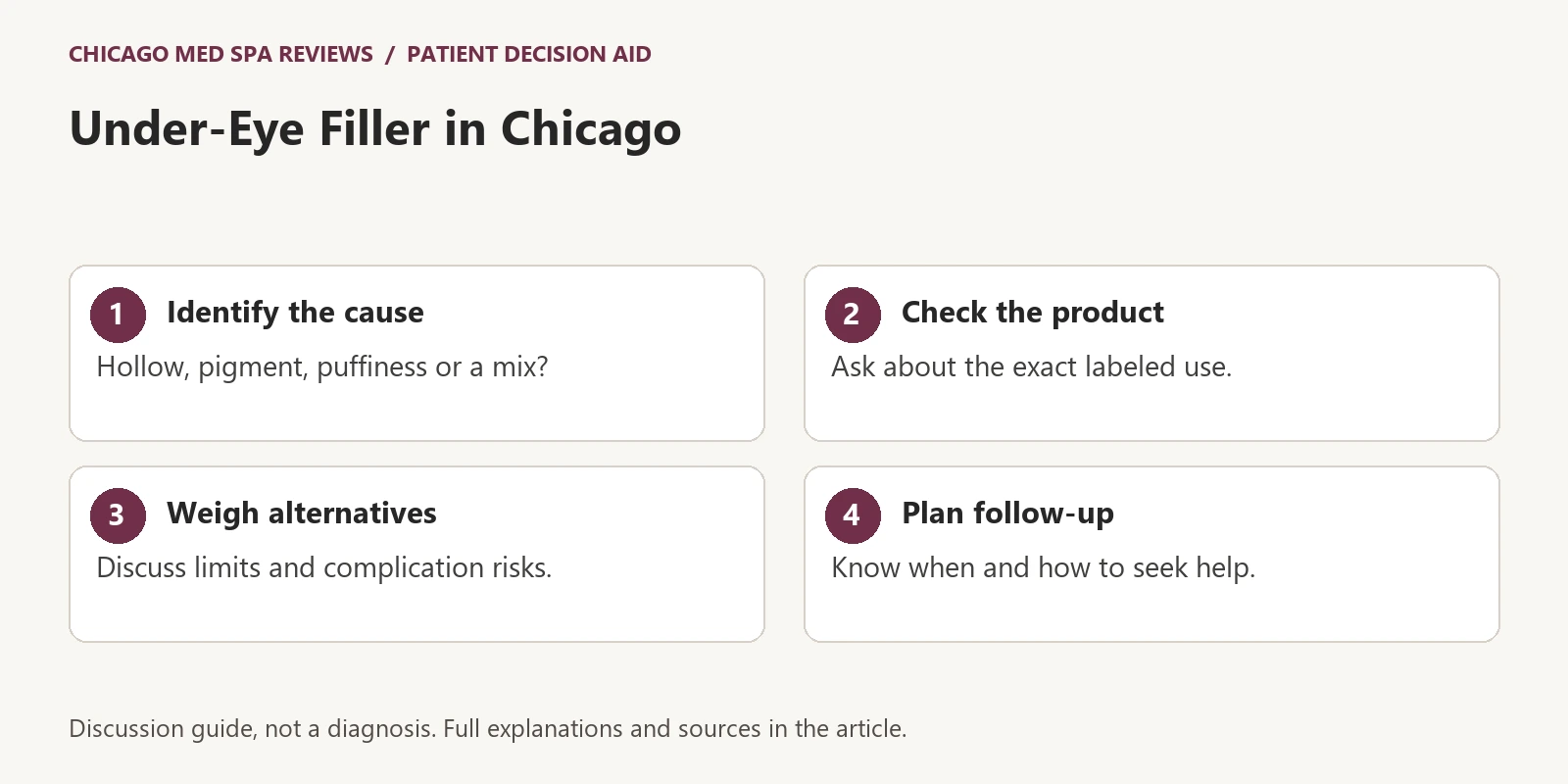
Use the four-step roadmap to organize your visit: Identify the cause, check the product, weigh alternatives, plan follow-up.
Use this candidacy discussion table
The table does not diagnose your under-eye area. It gives you a way to check whether the recommendation matches the concern and whether alternatives have been considered.
| Concern to assess | Question to ask | Why the answer matters |
|---|---|---|
| An apparent hollow | Is loss of volume the main problem? | Filler adds volume rather than addressing every cause of color |
| Dark color without a clear hollow | Could pigment or visible vessels be contributing? | A volume treatment may not address the main concern |
| Bags or puffiness | Could adding volume make the appearance worse? | Puffiness may need dermatology or oculoplastic assessment |
| Previous under-eye filler | What product remains and how does it affect the plan? | More filler is not an automatic next step |
Check the exact product and indication
The FDA consumer update includes under-eye hollows among approved uses of certain fillers. That is not a statement that every filler is approved for that area. Request the exact product and its patient labeling, and ask whether your proposed use matches the label or is off-label.
The FDA device overview explains that approvals cover specific uses. Ask about the eligible age group and limitations for the named product rather than relying on a general claim that the clinic uses approved filler. If the plan is off-label, ask why and how the clinician explains the evidence and additional uncertainty.
Discuss risk before discussing a syringe
Ask about swelling, persistent puffiness, contour irregularities, color changes and the possibility that the result will not address the concern. Rare vascular complications can be serious, including loss of vision. No injection technique should be presented as a guarantee that these risks are eliminated.
Request a complication plan and an after-hours contact. New vision changes, facial weakness, trouble speaking or other stroke-like symptoms after filler require calling 911 immediately. Severe or worsening pain or skin suddenly becoming pale, gray, blue or mottled also needs immediate medical attention. Do not wait for a scheduled review; alert the treating clinician after arranging urgent care.
Discuss whether a dermatology or oculoplastic assessment, a different treatment, or no procedure would better fit the findings. Our filler dissolving guide explains why reversal also needs an assessment and is not a guarantee of returning to the original appearance.
A practical example: ask what the quote is buying
Imagine a Chicago patient with dark circles who receives a message offering one syringe. Before comparing the price, the patient should ask whether an examination found a hollow, whether the quote is for both sides and what result is realistic. A quantity alone is not a diagnosis or a plan. This is a hypothetical example, not a dosing suggestion.
Request the consultation charge, product name, total estimated fee, review policy and charges for reassessment or correction. Ask how the clinic handles unused product and whether a follow-up is included. Our dermal filler cost guide explains pricing bases; this article does not establish a Chicago average.
Ask who examines you and performs the injections, their license types, and who is responsible for complications. Verify names through our Illinois license guide. Ask how long the named product may last, what maintenance entails and which medicines or supplements need review before treatment.
- Bring records of previous filler and eye-area procedures.
- Ask the clinician to identify the main cause of the appearance.
- Request product labeling and a discussion of alternatives.
- Agree on a review plan before considering additional filler.
- Get written instructions for urgent symptoms and routine concerns.
Evaluate the result with consistent photographs
Ask when your clinician wants to assess the outcome and how to distinguish expected recovery from a concern that warrants an earlier call. Compare photographs in similar lighting and at the same angle; a change in overhead lighting can dramatically alter the look of a hollow.
Plan the appointment around access to follow-up rather than a short gap before travel or an important event. The first-visit checklist helps organize the remaining questions. This is an editorial consultation guide, not a determination that you are a candidate.
Our Botox versus filler guide explains the broader distinction between muscle-relaxing and volume treatments. Neither category replaces an assessment of the cause of an under-eye concern.
Frequently Asked Questions
Does under-eye filler remove dark circles?
It may help when a hollow and its shadow are part of the problem, but dark circles can have other causes. Ask the clinician to explain what is creating the appearance and which part filler could address. Pigmentation or puffiness should not automatically lead to a recommendation to add volume.
Is under-eye filler FDA approved?
Certain fillers have approved indications for under-eye hollows, but approval is product-specific. Request the exact product name, patient labeling and intended use, including the eligible age group. Ask whether the proposed treatment matches that labeling or is off-label instead of accepting a general claim that all filler is approved.
Can under-eye filler be dissolved if I dislike it?
Hyaluronic acid filler can sometimes be broken down with hyaluronidase, but reversal is a separate medical decision with risks and limitations. Non-HA materials are not dissolved that way. Confirm the original product and the cause of the concern, and do not assume a perfect correction is guaranteed by another injection.
How do I compare under-eye filler prices in Chicago?
Compare an examined treatment plan, not simply a syringe price. Ask which product and area the quote covers, whether both sides are included, and what review or correction costs. This guide has no verified local price sample. A cheaper quote does not answer questions about candidacy or complication management.
Sources
- Eyelid Filler Injection, EyeWiki, American Academy of Ophthalmology
- Dermal Fillers (Soft Tissue Fillers), U.S. Food and Drug Administration
- Dermal Filler Do's and Don'ts for Wrinkles, Lips and More, U.S. Food and Drug Administration